Open Access Molecular Data Astrochemistry

Meet

The Astrochemistry Low-energy electron Cross-Section database, or ALeCS, is a public database for electron-impact inelastic cross sections for atoms and molecules of astrochemical interest. The database aims to be significant repository of fundamental electron-impact data with readily accessible and readable data.

200+ Species
150+ Ionization energies
Networks UMIST & KIDA
Open Free & public
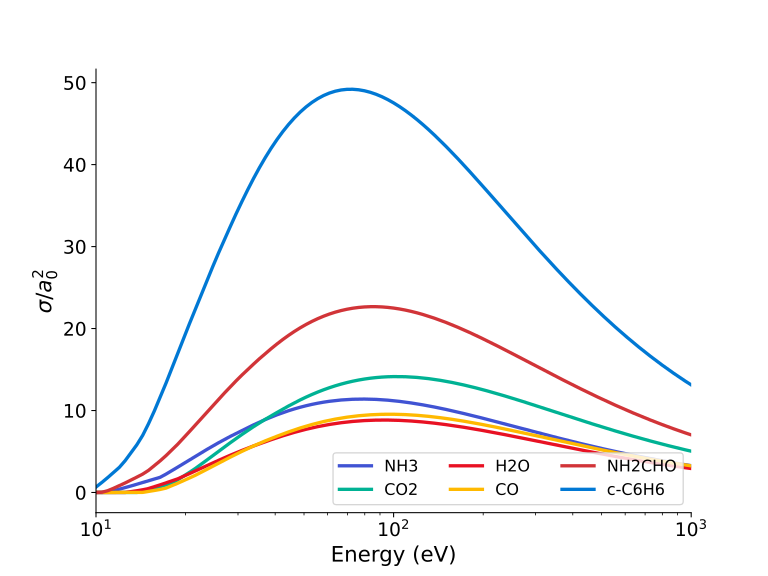
ALeCS Cross Section Plot

What ALeCS Contains

The current 2024 release of the database includes the total ionization electron-impact cross sections, molecule structures, atomic orbitals and computed ionization potentials for over 150 neutral molecules. Keep an eye out on future updates to the database!

Atomic Species
H, He, C, N, O. Energy ranges from threshold to 10 keV. Future goals to include S, P, Mg and Si.
Molecular Species
Diatomics up to complex organics, carbon chains and small PAHs
Cross Section Types
Currently, total ionization cross sections using the Binary Encounter Bethe (BEB) and Screening-corrected Additivity Rule (SCAR)
Vertical Ionization Energies
We have computed the vertical ionization energies for 150+ molecules using CAM-B3LPY-D3+, with a subset benchmarked against CCSD(T)/CBS calculations and compared to NIST data.
Optimized geometries
For all molecules in our database, we have the available optimized, with different subsets for three levels of theory, from Hartree-Fock to CCSD(T).
Ionization rates and networks
The interstellar ionization rate coefficients have been computed including secondaries and accounting for attenuation into clouds for systematic errors. Network files are available in the standard UMIST and KIDA formats.

How to Access the Database

ALeCS is freely available, with the main access point currently being the GitHub repository. We have planned future extensions to improve web access and python API.

01
Interactive Explorer
Browse and plot ionization cross sections directly in the browser using our Streamlit app.
Open Explorer →
02
GitHub Repository
All cross section data, optimized geometries, vertical ionization energies, ionization rates and chemical network files are available on our GitHub repository. We also include python scripts which show how the various cross sections are computed from the orbital data.
View on GitHub →
03
Citing ALeCS
If you use ALeCS data in published work, please cite the relevant release papers, and any additional papers as described in the documentation.
@ARTICLE{Gaches2024, author = {{Gaches}, Brandt A.~L. and {Grassi}, Tommaso and {Vogt-Geisse}, Stefan and {Bovolenta}, Giulia M. and {Vallance}, Claire and {Heathcote}, David and {Padovani}, Marco and {Bovino}, Stefano and {Gorai}, Prasanta}, title = "{The Astrochemistry Low-energy Electron Cross-Section (ALeCS) database I. Semi-empirical electron-impact ionization cross-section calculations and ionization rates}", journal = {arXiv e-prints}, keywords = {Astrophysics - Astrophysics of Galaxies, Astrophysics - Instrumentation and Methods for Astrophysics, Physics - Chemical Physics}, year = 2023, month = oct, eid = {arXiv:2310.10739}, pages = {arXiv:2310.10739}, doi = {10.48550/arXiv.2310.10739}, archivePrefix = {arXiv}, eprint = {2310.10739}, primaryClass = {astro-ph.GA}, adsurl = {https://ui.adsabs.harvard.edu/abs/2023arXiv231010739G}, adsnote = {Provided by the SAO/NASA Astrophysics Data System} }

Browse & Visualize Cross Sections

Use the embedded data explorer to plot ionization cross sections for up to 5 species, and export data as a csv all within the browser.

https://alecsapp.streamlit.app — Mini ALeCS

Advisory Board

ALeCS is now organized through an advisory board, which helps drives the long term growth and management of the database. The advisory board has members from several different countries, including both astronomers and chemists. The board was established April 2026 with the adoption of the bylaws.

Dr. Brandt A. L. Gaches
Chair
Emmy Noether Junior Group Leader
University of Duisburg-Essen, DE
Prof. Dr. Stefano Bovino
Technical Team
Professor
Sapienza University of Rome, IT
Dr. Giulia Bovolenta
Postdoctoral Researcher
Atomistic Simulations, Italian Institute of Technology, IT
Dr. Prasanta Gorai
Dr. Prasanta Gorai
Technical Team
Postdoctoral Researcher
University of Oslo, NO
Dr. Tommaso Grassi
Dr. Tommaso Grassi
Technical Team
Scientist
Max Planck Institute for Extraterrestrial Physics, DE
Dr. Marco Padovani
Dr. Marco Padovani
Scientist
INAF-Osservatorio Astrofisico di Arcetri, IT
Prof. Dr. Stefan Vogt-Geisse
Professor
Universidad de Concepción, CL
Prof. Dr. Claire Vallance
Professor
University of Oxford, UK

Funding & Institutional Support

ALeCS has been made possible through the Origins Postdoctoral Fellowship held by the PI, Dr. Brandt Gaches, from 2022-2025 funded through the ERC Advanced Grant MSTAR, at Chalmers University of Technology. The 2024 Release data was calculated on machines supported by the Chalmers Centre for Computational Science and Engineering (C3SE). Models are now run on a server supported by the University of Duisburg Essen Zentrum für Informations-und Mediendienste (ZIM), funded by the Emmy Noether fellowship, DFG Project ID 542802847.

Open for Collaboration
& Data Requests

We welcome collaborations with other interested researchers wishing to expand the database, and scientists who are in need of fundamental electron-impact cross section. Currently, we can only support the generation of new electron-impact cross sections and vertical ionization energies.

  • Data contributions — Submit new cross section data for review and inclusion in the database.
  • Data requests — Request cross sections for specific atoms or molecules relevant for your work.
  • Feature expansion - Are we missing a key feature that you would be interested in adding?

Get in Touch

If you have need of specific data, or have your own data you wish to add to the database, don't hesitate to reach out! You may use the form below, or — even better — open a Discussion on our GitHub to begin a conversation.

Or start a discussion directly on GitHub:

Open GitHub Discussion

We will try to readily respond · please be patient!